
Precision grooming guide
Mustache Shaver Guide: How to Get Clean Edges Without Irritation
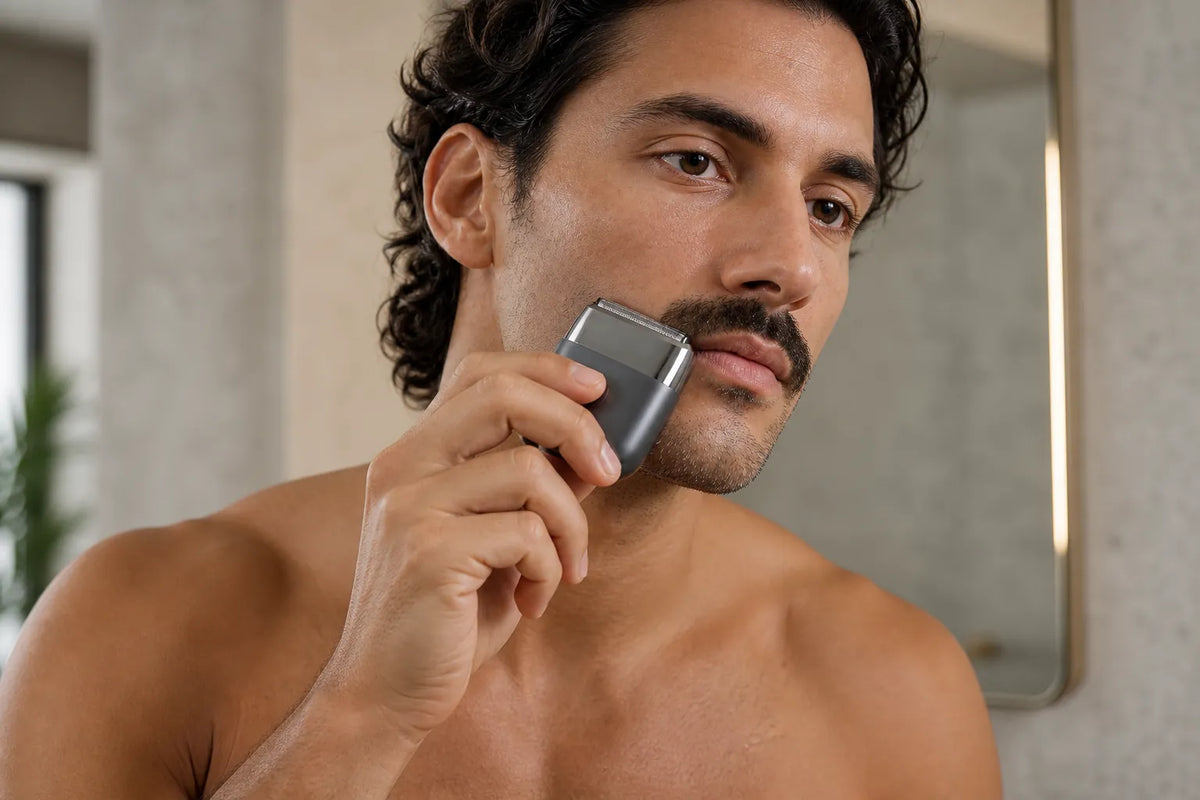
A clean mustache edge comes from using two different actions for two different jobs: trim the longer mustache hairs to shape the style, then use an electric foil shaver only on the short stubble outside that boundary. Start away from the line, approach it with light, short passes, and stop as soon as the surrounding skin looks clean. That is more controlled than pressing a wide foil head into the mustache and repeatedly chasing a sharper line.
No shaving method can guarantee zero irritation. Skin condition, hair direction, tool condition, pressure, and the number of passes all matter. This guide shows how to reduce common triggers while keeping the upper lip and mustache corners deliberate.

What makes mustache grooming different?
The mustache occupies a small, curved area between the nose and upper lip. Its hairs may be longer than the surrounding stubble, while the corners can grow in different directions from the center. That means one sweeping motion rarely controls everything well.
A useful routine separates three tasks:
- Length control: shorten hairs that cover the lip or extend beyond the intended shape.
- Outline control: decide where the top, bottom, and side boundaries should sit.
- Skin cleanup: remove short stubble outside the outline without repeatedly shaving the same strip of skin.
A guarded detail trimmer or rounded-tip grooming scissors handles the first task. A comb and bright mirror help with the second. A compact foil shaver handles the third. Calling every one of those tools a “mustache shaver” can blur their roles, so check what a product is actually designed to cut.
Mustache shaver or trimmer: which tool does what?
| Grooming task | Best starting tool | Why |
|---|---|---|
| Shorten the mustache evenly | Guarded detail trimmer | A guard preserves a repeatable length instead of cutting directly to the skin. |
| Remove individual hairs over the lip | Fine comb and rounded-tip grooming scissors | The comb reveals only the hairs that extend beyond the chosen line. |
| Clear short stubble above or beside the mustache | Compact foil shaver | The foil is intended to shave short hair close while shielding the moving cutters. |
| Create a very narrow pencil outline | Precision trimmer first, foil shaver second | The narrow tool establishes the line; the foil cleans the open skin around it. |
| Maintain short mustache stubble | Guarded trimmer | A foil shaver removes hair too closely to preserve visible stubble. |
If a foil shaver does not include a detail-trimmer attachment, do not treat the edge of its foil as a substitute. Long hairs can fold away from the foil, and a broad head can remove more of the boundary than intended. Trim the shape separately, then use the foil on the exposed skin.

Map the mustache edge before you switch on the shaver
Good symmetry starts with a reference, not with removing more hair. Comb the mustache in its natural direction and look straight into a well-lit mirror. Do this while the hair is dry, because wet hairs can lie longer or flatter and change position as they dry.
The top edge
Most natural mustaches follow the growth line below the nose rather than creating a perfectly straight band. Remove obvious stray stubble above that growth line, but preserve the center if the mustache naturally rises toward the philtrum. A line that follows your growth pattern usually requires less daily correction.
The lower edge
Comb the hair downward and decide how much upper-lip visibility you want. For a neat everyday finish, trim individual hairs that cross the lip instead of pushing a foil head upward into them. Keep scissors pointed away from the skin, use a stable mirror, and cut very small amounts.
The side edges
Choose whether the mustache ends at the mouth corners, extends slightly beyond them, or connects to beard growth. Mark both endpoints visually before removing hair. Work from the open cheek toward each endpoint and alternate sides. This prevents one side from getting progressively shorter while you try to match the other.
Leave a margin for correction
On the first pass, stop just outside the line you think you want. Step back from the mirror and check the full face. You can remove another millimeter; you cannot put it back. This small pause is one of the easiest ways to avoid an uneven mustache.
How to use a mustache shaver step by step
- Check the skin and the tools. Do not shave over cuts, active irritation, or raised spots. Make sure the foil is clean, undamaged, correctly seated, and charged enough that it will not slow during the routine.
- Comb and trim the mustache body. Work on dry hair. Use a guard for overall length, then comb downward and remove only the hairs that cross your chosen lower edge. If the mustache is long, finish this step before any close shaving.
- Confirm the boundary. Identify the center, both corners, and the top growth line. Compare the two sides from normal viewing distance instead of leaning extremely close to the mirror.
- Choose dry or wet preparation. For a dry routine, wash the area, remove oil and product residue, and let it dry fully unless your device says otherwise. For a wet routine, use warm water and a thin layer of compatible shaving cream or gel only if the shaver is approved for wet use.
- Make the upper lip stable. Press the lips together gently or make a slight closed-mouth smile. Do not pull the skin aggressively taut. You need a steady surface, not maximum tension.
- Start on open skin. Place the foil flat on the cheek or skin outside the mustache corner. Use very light pressure. Move toward the border with short strokes or small controlled arcs that follow the manufacturer's technique.
- Approach the line gradually. Stop before the foil overlaps the longer mustache hairs. Lift the shaver, inspect the edge, and make a second short pass only where visible stubble remains.
- Work under the nose carefully. Keep the foil clear of the nostrils and lip. Angle the head so its full foil surface—not a sharp corner of the housing—touches the skin. If the head is too wide for the space, leave that spot for a narrower detail tool.
- Alternate sides. Clean a small area on one side, then match it on the other. Do not finish one entire side before looking at the second.
- Rinse and calm the skin. Remove all cream or hair residue, apply a cool damp cloth if the area feels warm, pat dry, and use a simple fragrance-free moisturizer if your skin tolerates it. Stop using any aftershave that burns or stings.
If you want the broader sequence for cheeks, jaw, and neck as well, read how to shave with an electric razor. The mustache-specific difference is that you are approaching a preserved hair boundary, not clearing an entire area.
Adjust the technique to your mustache style
| Style | Preserve | Clean with the foil shaver |
|---|---|---|
| Natural mustache | The original top growth line and soft corners | Obvious stray stubble above the line and outside the corners |
| Chevron | Full center density and a broad lower shape | Cheek stubble beyond the endpoints; trim over-lip length separately |
| Pencil mustache | A narrow, consistent strip | Open skin above and below only after a precision tool establishes the strip |
| Disconnected mustache | Clear space between mustache and beard | Short stubble in the connector area using short, measured passes |
| Mustache stubble | An even visible length | Only the skin outside the intended stubble zone; use a guard within it |
Whichever style you choose, follow your actual growth rather than an idealized template. Hair density, direction, lip shape, and facial proportions differ. A slightly softer natural line often looks cleaner than a severe line that needs repeated corrective passes.
Ten mustache-shaving mistakes that can spoil the edge
- Using a foil shaver to cut long mustache hair. Trim bulk first so the foil only has to capture short stubble.
- Starting directly on the boundary. Begin on open skin and approach the line so you can stop before removing too much.
- Pressing harder for a closer result. Pressure can increase friction and may flatten hair away from the foil openings.
- Going over the same strip repeatedly. Inspect after one or two controlled passes instead of polishing an area that is already clean.
- Shaving against every direction of growth. Map the grain and use the gentlest effective route, especially if you are prone to bumps.
- Stretching the upper lip very tight. Keep it stable without pulling it taut.
- Chasing perfect symmetry millimeter by millimeter. Repeated corrections can make both sides progressively narrower.
- Using wet products with a dry-only shaver. Confirm wet-use compatibility in the manual first.
- Ignoring a damaged or dirty foil. Stop if the foil is dented, rough, or not seated correctly.
- Shaving irritated skin again the next day. Give the area time to settle and seek professional advice if bumps, pain, or inflammation persist.
For coarse or multi-directional facial hair, section-by-section grain mapping matters more than force. Our guide to choosing an electric shaver for coarse hair explains the relevant shaver features in more detail.
What to look for in a mustache shaver
- Compact head and body: easier handling helps when you are working beside a narrow boundary.
- Floating foil system: movement can help the cutting surface maintain contact across the curves beside the mouth.
- Low-force cutting: the shaver should capture short stubble without requiring pressure or repeated scraping.
- Wet/dry compatibility: useful if you want to compare a fully dry routine with a lubricated routine, but only when explicitly supported.
- Easy head removal and cleaning: short facial hair and product residue collect quickly around the foil.
- Travel lock and protective cap: helpful if the tool lives in a toiletry bag.
- Replacement-part guidance: foils and cutters wear. Follow the maker's replacement interval rather than waiting for pulling or roughness.
A precision trimmer attachment can be useful, but verify that it is actually included. Product names and customer reviews are not a substitute for the current box list.
Using the Nuvy Nova as a mustache-edge cleanup shaver
The Nuvy Nova Shaver is an ultra-compact foil system designed for wet or dry shaving. The current product page lists three floating blades, an ultra-thin foil, IPX7 waterproofing, a detachable head, and a travel lock activated by holding the power button for three seconds. Its published dimensions are 80.5 × 63 × 31 mm and its weight is 155 g.
For a mustache, use that compact body to clean the bare skin above or beside an already trimmed outline. The manufacturer's current instructions call for slow circular movement with gentle pressure. Near an edge, keep those circles or arcs small, start outside the mustache, and stop before the foil overlaps the longer hairs.
The current package list includes the shaver, protective cap, user manual, Type-C charging cable, cleaning brush, and protective case. It does not list a precision trimmer attachment. Use a separate guarded detail trimmer or grooming scissors when you need to shorten or sculpt the mustache itself.
Wet use is optional, not mandatory. If you use cream or gel, keep the layer thin enough to see the boundary, rinse it away thoroughly, and follow the product's cleaning instructions. If you prefer a dry routine, our pre-shave lotion guide explains how dry pre-shave products differ from lather. You can compare current compact models in NuvyCare's electric shaver collection.
Clean the shaver after detailed upper-lip work
Hair fragments and product residue can obstruct a foil and make later passes less consistent. Switch the unit off and unplug it. On the Nova, pull the head upward to remove it, then rinse or brush it according to the manual. The live specification warning says to separate the handheld unit from the power cord before water cleaning and never charge it in a damp environment.
Shake off excess water gently, allow the parts to dry fully, and reassemble only when clean and dry. Do not tap a delicate foil against the sink or scrub it with a hard brush. For a more detailed maintenance routine, see how to clean an electric shaver.

Quick mustache-edge checklist
- Comb and trim long mustache hairs before close shaving.
- Choose the top, lower, and side boundaries before removing hair.
- Confirm whether the shaver supports wet use.
- Place the foil on open skin and approach the line gradually.
- Use light pressure, short passes, and the direction recommended for your hair and device.
- Alternate sides instead of perfecting one side first.
- Stop when the edge is clean; do not keep polishing it.
- Rinse the skin, moisturize if tolerated, and clean the shaver.
Frequently asked questions
Can I shape a mustache with an electric shaver?
You can use a foil electric shaver to clean short stubble outside an established mustache shape. Use a guarded detail trimmer, comb, or grooming scissors to shorten and define the longer mustache hairs first. A wide foil head is not a substitute for a narrow precision trimmer.
What is the best way to get a clean mustache edge?
Comb and trim the mustache while dry, decide where both corners and the top line should sit, then start the shaver on open skin and approach the boundary with light, short passes. Alternate sides and stop before the foil overlaps the longer hairs.
Should I shave above my mustache with or against the grain?
Map the direction your facial hair grows and begin by shaving with that direction, especially if you are prone to razor bumps. Follow the motion recommended by your shaver's manufacturer, use light pressure, and avoid repeatedly reversing direction over the same skin.
Can I use shaving cream with a mustache shaver?
Only if the shaver is approved for wet use. Apply a thin, compatible cream or gel so you can still see the mustache boundary, then rinse the skin and clean the shaver as directed. For a dry-only device, keep the skin and foil dry.
How do I avoid irritation when shaving around my upper lip?
Use a clean, undamaged foil, light pressure, short passes, and the lowest number of passes that removes the visible stubble. Do not stretch the skin tightly or shave over active irritation. Rinse afterward, apply a cool damp cloth if needed, and use a fragrance-free moisturizer if tolerated.
How often should I clean an electric mustache shaver?
Remove loose hair after every use and follow the manufacturer's full cleaning schedule. If you use cream or gel, clean compatible washable parts immediately so residue does not dry around the foil. Always switch off and unplug the shaver before cleaning.
Share:
Curl Styler Brush Guide: How to Choose and Use the Right Brush
Flat Iron vs Hair Straightener: Which One Fits Your Routine?