HAIR TOOL BUYING GUIDE
Flat Iron vs Hair Straightener: Which One Fits Your Routine?
A flat iron is a type of hair straightener, but not every hair straightener is a flat iron. Flat irons press dry hair between two heated plates. The wider straightener category also includes hot brushes, straightening combs, steam tools, and airflow-based models designed to dry and smooth damp hair. The best choice is therefore not about which name sounds more professional—it is about which mechanism fits your starting hair, preferred finish, and daily routine.

Flat Iron vs Hair Straightener: The Short Answer
In everyday conversation, “flat iron” and “hair straightener” are often used as synonyms. That is understandable: both terms can describe the familiar hinged tool that closes around a section of hair. But when you compare products, hair straightener is the umbrella category, while flat iron usually means a two-plate contact tool.
Choose a conventional flat iron when your hair is already completely dry and your priority is a crisp, polished, flatter finish. A narrow, rounded plate tool may also be useful if you want to bend ends or create curls with the same device. Choose a purpose-built airflow or wet-to-dry straightener when you commonly begin with damp hair and want drying and straightening to happen within one coordinated routine.
The most important rule: never assume a tool is safe for damp hair because the listing calls it a “straightener.” Use a conventional flat iron only on fully dry hair unless its manufacturer explicitly states that the exact model is designed for damp-to-dry use.
Neither mechanism is automatically better for every person. A tool that removes a step on wash day may feel transformative for one routine and unnecessarily bulky for someone who only makes quick dry-hair touch-ups. Start with the job you need the tool to do, then compare specifications.
How Different Hair Straighteners Work
Marketing language can blur meaningful mechanical differences. Before comparing temperatures, plate materials, or price, identify what actually transfers heat or creates tension through the section.
Conventional flat iron: direct plate contact
A flat iron closes two solid heated plates around dry hair. The plates supply direct contact heat while the user’s hand supplies tension and movement. Working in thin, even sections helps the plates contact the hair consistently. The characteristic result is controlled and sleek, although the exact finish depends on plate width, edge shape, technique, hair texture, and setting.
Direct contact is also why preparation matters. Hair should be fully dry, detangled, and treated with a heat protectant that suits both your hair and the tool. Turning the dial higher does not replace sectioning. The American Academy of Dermatology recommends using the lowest heat setting that works and limiting how often you use heat; repeated excessive heat can damage hair of any type.
Airflow or wet-to-dry straightener: moving air plus tension
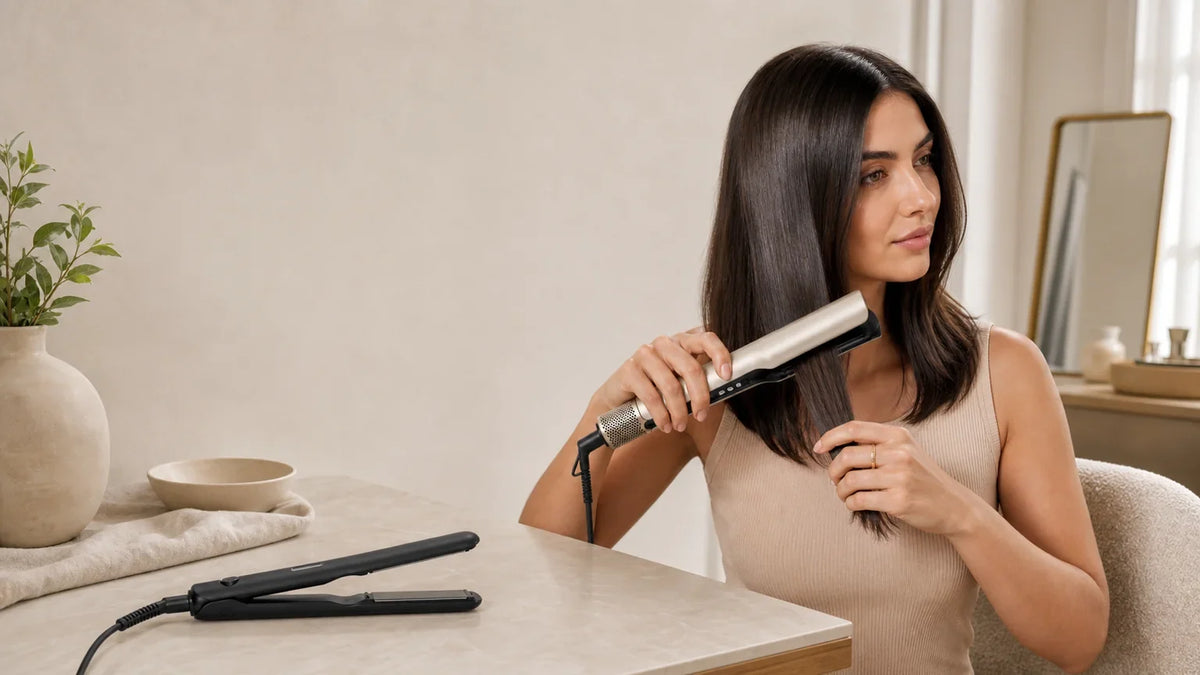
An airflow straightener directs heated air along a controlled section while the tool’s arms or tension surfaces guide it. A model explicitly designed for damp hair can remove moisture and smooth the section in the same workflow. It is not simply a flat iron with a new name: the air path, intake, body shape, operating sound, size, and handling can all be different.
“Wet-to-dry” should not be read as “use on dripping hair” or “guaranteed one pass.” Towel-blotted damp hair, small sections, hair density, texture, porosity, and the chosen setting all affect timing. Follow the exact manufacturer instructions supplied for the model rather than borrowing a routine from another device.
Hot brush or straightening comb: open contact
A heated brush or comb moves through hair with open teeth or bristles rather than clamping it between two surfaces. It can be useful for smoothing, softening bends, and retaining some body. Because the hair is not pressed flat between plates, the finish may look fuller and less glass-straight than a flat iron result. Some tools are intended only for dry hair; others combine airflow with bristles. Again, the product instructions decide the starting moisture.
What this comparison does not include
Chemical straightening services change the hair through a different process and carry different maintenance and safety considerations. This guide compares at-home electric styling tools only. It also does not treat every device with a clamp shape as the same technology.

Flat Iron vs Hair Straightener: Side-by-Side Comparison
| Decision point | Conventional flat iron | Airflow or wet-to-dry straightener |
|---|---|---|
| Starting hair | Fully dry unless the exact model explicitly says otherwise | Damp, towel-blotted hair when the exact model is designed for wet-to-dry use |
| Main mechanism | Direct heat from two solid plates plus hand-applied tension | Directed heated airflow plus guided tension surfaces |
| Typical finish | Crisp, smooth, flatter, and highly polished | Smooth with more natural movement and body |
| Place in the routine | After drying; useful for finishing and touch-ups | Can combine the drying and straightening stages on wash day |
| Root access | A slim tool can be precise near roots and short layers | A larger airflow body may need more room around roots |
| Curling versatility | Rounded-edge models can create bends or curls with practice | Clamp-style airflow tools are generally optimized for smoothing, not wrapping curls |
| Size and sound | Often compact and quiet apart from control sounds | Typically larger and produces fan noise while moving air |
| Speed advantage | Fast when hair is already dry and needs targeted polishing | Can save a separate drying step when hair begins damp |
| Travel fit | Compact models are easier to pack, but voltage still matters | Body and intake may take more luggage space; voltage still matters |
The “speed” row needs context. If you wash your hair, blow-dry it fully, and then flat iron it, a wet-to-dry device may shorten the whole sequence. If your hair is already dry and only the ends need refreshing, switching on an airflow tool may not save time. Compare complete routines, not a single pass demonstrated on one section.
Which Tool Fits Your Routine?
Choose a conventional flat iron if you style fully dry hair
A flat iron makes sense when drying and straightening are separate steps in your routine. It is well suited to second-day touch-ups, smoothing a fringe, refining ends, or creating a very straight finish. People who travel frequently may also prefer a smaller plate tool—provided its rated voltage and plug are compatible with the destination.
Choose an airflow straightener if wash-day efficiency matters
If you regularly move from towel-dried hair to a smooth finish, an airflow model designed for damp use can consolidate two stages. The tradeoff is usually a larger body, fan sound, and a finish that may retain more natural volume. That is an advantage if you dislike a compressed look, but it may not satisfy someone seeking an ultra-flat result.
Choose by finish, not by trend
Think about the last two inches of your hair and the shape around your face. A flat iron can create a sharp line, tuck ends under, or—with suitable rounded edges and technique—form loose bends. A clamp-style air straightener primarily guides hair in a straighter path. It may create a soft turn at the ends, but it should not be purchased as a substitute for a dedicated curling tool unless the maker demonstrates that use.
Choose by hair condition as well as texture
Fine, coarse, straight, curly, high-density, and low-density hair do not all respond alike. More importantly, bleached, relaxed, weathered, or breakage-prone hair may tolerate less heat than untreated hair of the same diameter. Do not let a “thick hair” label push you toward maximum settings. For a deeper feature checklist, see our guide to choosing a hair straightener for thick hair.
Choose by the routine you will repeat
A tool should be comfortable on section ten, not only attractive in a product photo. Consider weight, grip, hinge resistance, cord movement, storage, cleaning, and how often you will use it. A device that is technically powerful but tiring to hold can lead to rushed, oversized sections and repeated passes.
Two Practical Styling Routines
These are general frameworks, not replacements for the instructions supplied with your exact device. If your tool’s manual gives different preparation, cleaning, or operating directions, follow the manual.
Routine A: conventional flat iron on dry hair
- Dry completely. Do not close an ordinary plate iron on damp or wet hair.
- Detangle gently. Remove knots from ends upward so the tool can move without snagging.
- Apply compatible protection. Use a heat protectant as directed and avoid leaving hair saturated with product.
- Divide the hair. Clip away the upper layers and begin with narrow, consistent sections at the nape.
- Start conservatively. Select the lowest effective setting and test a hidden section before increasing it.
- Use one controlled motion. Close the plates gently and move steadily from near the root toward the ends without pausing in one place.
- Let the result cool. Assess the section after it cools instead of immediately repeating the pass.
- Switch off and unplug. Place the tool on a heat-safe surface and let it cool fully before storage.
Routine B: purpose-built wet-to-dry airflow straightener
- Remove excess water. Gently towel-blot after washing; hair should be damp rather than dripping.
- Detangle and protect. Use products compatible with damp hair and the manufacturer’s directions.
- Check the roots. If the manual calls for pre-drying roots or a particular starting moisture, complete that step.
- Create manageable sections. Keep the opening clear enough for air to travel through the whole section.
- Select a suitable setting. Begin conservatively and adjust based on the hair’s response, not a maximum-number goal.
- Guide from roots to ends. Keep a controlled pace and avoid repeatedly squeezing the same spot.
- Confirm dryness. Before finishing, check hidden layers and roots rather than judging only the surface.
- Power down safely. Switch off, unplug, and allow the intake and body to cool before cleaning or storage.

Seven Comparison Mistakes to Avoid
- Buying by category name alone. “Straightener” does not tell you whether the tool uses plates, bristles, steam, or airflow.
- Using a conventional flat iron on wet hair. Damp-use permission must come from the exact manufacturer instructions.
- Assuming wet-to-dry means one pass for everyone. Density, texture, section size, starting moisture, and setting change the result.
- Choosing maximum heat by default. Better preparation and smaller sections often improve consistency without an automatic temperature increase.
- Expecting identical finishes. Direct plates commonly create a flatter polish; airflow models can retain more movement.
- Ignoring weight and maintenance. A fan, intake, and larger body change how a tool feels and how it should be cleaned.
- Checking the plug but not the voltage. A travel plug adapter changes the shape of a connection; it does not convert the electrical voltage.
What to Check Before Buying Any Hair Straightener
A useful product comparison should answer the following questions clearly. If a listing leaves one unanswered, consult the manual or ask the seller before purchase.
- Starting moisture: Does the manufacturer explicitly permit damp-hair use, or is the tool dry-only?
- Mechanism: Are solid plates supplying direct contact heat, or does the device use heated airflow, bristles, steam, or a combination?
- Controllable settings: Can you choose a lower effective output for fragile areas rather than relying on one high setting?
- Handling: What are the complete weight, cord length, grip dimensions, and working width?
- Safety: Is there an automatic shut-off, a heat-safe resting surface, and clear cooling guidance?
- Electrical compatibility: What rated voltage, frequency, wattage, and plug does the exact unit use?
- Maintenance: How should plates, tension surfaces, filters, or air intakes be cleaned?
- Included items: Does the package include a mat, storage case, or other accessory you actually need?
If your main uncertainty is heat selection rather than mechanism, use our separate hair straightener temperature guide. Keeping the questions separate prevents a high maximum temperature from overshadowing the tool’s overall fit.
Where the NuvyCare Wet-to-Dry Hair Straightener Fits
The NuvyCare Wet-to-Dry Hair Straightener belongs on the airflow side of this comparison, not in the conventional solid-plate flat iron category. Its current product page describes high-speed airflow and temperature control intended to dry, straighten, and smooth damp hair in one coordinated step.
As of August 21, 2026, the live page lists a 100–230°C temperature range, 950W rated power, approximately 658g weight including the cord, an approximately 1.8m cord, and automatic shut-off after approximately 20 minutes. Beige and white color options are shown, and the current “What’s in the box” section lists the straightener and a heat-resistant mat.
Check electrical compatibility before ordering: the current product page lists a rated voltage of 220–240V and frequency of 50–60Hz. Do not assume the unit is compatible with standard North American household voltage, and do not assume a plug adapter converts voltage. Confirm the exact unit, plug, local supply, and any converter requirement with a qualified source before use.
This model is most relevant if your routine often begins with damp, towel-blotted hair and you value combining drying and smoothing. If you only touch up fully dry hair, want a compact travel tool, or prefer the most compressed plate-polished finish, a conventional flat iron may be the more direct choice. To understand the airflow workflow in more depth, read how a wet-to-dry hair straightener works.
The Verdict
The flat iron vs hair straightener question becomes easier once you stop treating the names as interchangeable specifications. A flat iron is the dry-hair, direct-plate option. A hair straightener may be a flat iron, but it may instead use a brush, comb, steam, or airflow. Read the mechanism and starting-moisture instructions before comparing temperatures.
For dry-hair precision, crisp polish, and compact touch-ups, a conventional flat iron is usually the clearer fit. For wash days when you want to move from damp hair toward a smooth finish without a separate blow-dry stage, a purpose-built airflow straightener may fit better. Whichever route you take, section carefully, use the lowest effective setting, minimize unnecessary passes, and make voltage compatibility part of the buying decision.
Frequently Asked Questions
What is the difference between a flat iron and a hair straightener?
A flat iron is a specific type of hair straightener that presses dry hair between two heated plates. Hair straightener is the broader category and can also include hot brushes, straightening combs, steam tools, and airflow-based wet-to-dry devices.
Is a flat iron the same as a straightener?
People often use the terms interchangeably, and many product listings do too. Technically, every flat iron is a straightener, but not every straightener is a flat iron because some models use airflow, bristles, comb teeth, or steam instead of two solid plates.
Can I use a flat iron on wet hair?
Do not use a conventional flat iron on wet or damp hair. Only use damp hair with a tool whose manufacturer explicitly says that the exact model is designed for wet-to-dry styling, and follow its preparation and operating instructions.
Is an air straightener better than a flat iron?
It depends on your routine. An air straightener can be a better fit when you want to combine drying and smoothing from damp hair. A flat iron can be better for compact dry-hair touch-ups, precise finishing, or a flatter plate-polished result.
Which tool is better for daily touch-ups?
If your hair is already dry and only a fringe, bend, or small section needs refining, a compact flat iron is often more direct. If most styling happens immediately after washing, a purpose-built wet-to-dry air straightener may save a separate drying stage.
What should I check before buying a hair straightener?
Check the styling mechanism, approved starting moisture, adjustable settings, weight, working width, cord, shut-off feature, cleaning instructions, rated voltage, frequency, wattage, plug, and included items. Confirm that the exact model is electrically compatible with the place where you will use it.
Share:
Mustache Shaver Guide: How to Get Clean Edges Without Irritation
What Is a Hot Air Styler? How It Dries, Smooths, and Curls