
ELECTRIC SHAVER TECHNOLOGY GUIDE
What Is a Floating Head Shaver? How Contouring Blades Follow Your Face
A floating head shaver is an electric shaver whose shaving elements can move slightly when they meet the skin. That controlled movement helps the cutting surface maintain more even contact as it travels from a flat cheek to the chin, jawline, or neck. The design can reduce gaps between the head and the skin—but it still depends on sensible preparation, light pressure, and deliberate passes.

What Is a Floating Head Shaver?
A floating head shaver is an electric shaver with one or more cutting elements mounted so they can travel a short distance under pressure and return to a neutral position. On a foil shaver, those elements may be narrow perforated foils and a central cutter supported by small internal springs or flexible mounts. As the head crosses a curve, one section can sit slightly higher or lower than another.
The purpose is contact consistency. A completely rigid, flat shaving surface naturally touches a flat cheek more easily than the corner of a jaw. When the individual elements have controlled movement, more of the active cutting area can stay near the skin while your hand changes direction. That can mean fewer missed strips and less temptation to compensate by pressing hard.
Plain-English definition: “floating” describes small, supported movement in the shaving elements. It does not mean that the head floats freely, predicts your face shape, or eliminates the need to guide the shaver.
Product descriptions sometimes use “floating head,” “flexing head,” “contour head,” and “pivoting head” as if they were interchangeable. They are related but not identical. A model may have independently moving foil sections, a head cassette that pivots as a unit, a flexible neck, or a combination of those systems. The product diagram and manual are more informative than the marketing label alone.
How a Floating Shaver Head Follows Facial Contours
A floating system works through several coordinated parts. The visible foil is only the surface that meets the skin; the cutting action happens beneath it, and the suspension controls how the assembly responds to changing angles.
1. The foil presents short hairs to the cutter
A foil is a thin perforated metal screen. As you move the shaver, short hairs enter its openings while the foil helps keep the fast-moving cutter from directly contacting the skin. Hole size, pattern, foil curvature, and the condition of the screen all influence how hair reaches the cutter. This is why a bent, cracked, or worn foil should not be treated as a minor cosmetic issue.
A foil shaver is usually most efficient on short stubble. Long, flat-lying, or tangled beard growth may not enter the openings cleanly. If growth has become longer than the shaver handles comfortably, shorten it with an appropriate trimmer before using the foil head rather than repeatedly scrubbing the same area.
2. Cutters oscillate beneath the foil
Inside the head, a motor drives cutters rapidly from side to side. Hairs that pass through the foil are cut between the moving cutter and the foil opening. The mechanism is different from a manual blade sliding directly across the skin, and it is also different from the circular cutting tracks found in a rotary shaver.
That distinction matters when comparing technique. Foil shavers are commonly guided with short, controlled strokes or the movement specified by the manufacturer. NuvyCare’s current Nova instructions describe slow circular movement with gentle pressure. Follow the manual for the exact unit rather than assuming every electric shaver needs the same pattern.
3. Supported sections move over a curve
When the head reaches the edge of the chin or jaw, the skin-facing elements do not all meet the surface at the same height. A floating mount allows the section encountering the highest point to compress slightly. Adjacent sections can remain closer to lower parts of the contour. The movement is small, but it can preserve useful contact across more of the head.

4. The suspension returns each element to neutral
After pressure is removed, the mount returns the section to its normal position. That restoring force matters: too little support would feel unstable, while a head that cannot move would behave like a fixed surface. The useful range is deliberately limited so the foils remain aligned with the cutter drive and head housing.
Floating movement is therefore not a reason to add pressure. Heavy pressure may compress every section at once, rub the foil against the skin, slow the motor, or deform a delicate screen. Let the suspension respond to the contour while your hand supplies direction—not force.
Floating vs Pivoting vs Fixed vs Rotary Shaver Heads
These terms describe different parts of the architecture. A shaver can belong to more than one column; for example, it may combine floating foil elements with a cassette that also tilts. Confirm what actually moves before judging the design.
| Head type | What moves | Likely advantage | Important limit |
|---|---|---|---|
| Floating foil elements | Individual foil or cutter sections move a short distance | Helps the active surfaces meet small changes in contour | Movement is limited and does not replace careful hand position |
| Pivoting cassette or neck | The full head tilts as one assembly | Helps the head change its overall angle across a broad curve | Individual elements may still be fixed within the cassette |
| Fixed foil head | The shaving surface remains rigid relative to the body | Simple, predictable head position | Your wrist must make more of the angle adjustment |
| Rotary head | Circular cutting units may flex, tilt, or float | Can approach hair from multiple directions over rounded areas | It uses a different cutting geometry and is not the same as a foil shaver |
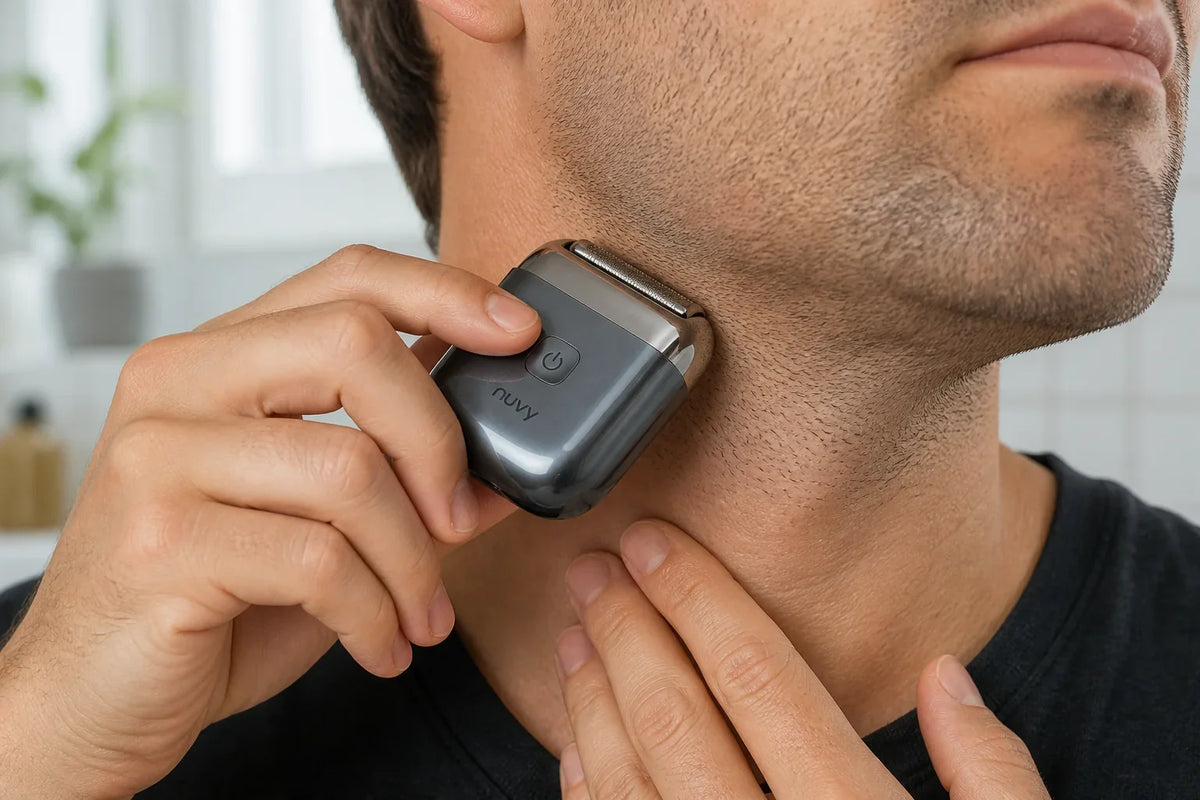
The Nuvy Nova is a compact foil shaver, not a rotary shaver. Its rectangular cutting surface shows the familiar foil architecture rather than three circular rotary tracks. For a broader explanation of the two categories, read our rotary vs foil shaver comparison.
What “three floating blades” means—and does not mean
On the current Nova product page, “three floating blades” refers to the supported shaving sections in the head. In practical terms, the visible arrangement consists of two outer foil areas and a central cutter section designed to work together while meeting the face. “Blade” is convenient product language, but it should not be interpreted as three exposed manual-razor blades.
It also does not prove that the complete head housing pivots through a large angle. The observable and documented claim is movement in the shaving system, so that is the useful basis for explaining the Nova. If broad neck articulation is important to you, look for an explicit pivot-angle specification or test the exact model rather than inferring it from the word “floating.”
What a Floating Head Can Improve
The design is most relevant wherever facial geometry changes quickly. Cheeks are comparatively broad and flat; the point of the chin, corners of the mouth, jaw edge, and upper neck demand more frequent angle changes. A compliant head can make those transitions feel less abrupt.
More consistent contact
When supported sections respond independently, a greater portion of the head may remain in working contact during a pass. Consistent contact can reduce narrow missed bands that otherwise encourage another pass. The goal is not to flatten the skin beneath the shaver; it is to let the head meet the surface without forcing it.
Less need to chase contours with pressure
A rigid tool often prompts users to push harder when a corner loses contact. A floating design gives the hardware some ability to accommodate that corner. Good technique still uses the wrist and free hand, but the response of the head can make light pressure more practical.
A compact head for targeted areas
Head size matters alongside movement. A small rectangular foil can be easier to place beneath the nose, beside a mustache line, or along a narrow jaw than a large cassette. Our guide to lightweight compact shavers explains the handling and everyday-carry tradeoffs in more detail.
What floating movement cannot guarantee
A floating head cannot make every beard hair stand upright, erase differences in hair density, or guarantee a perfectly close result in one pass. It does not prevent irritation by itself, and it cannot compensate for a dirty foil, damaged screen, worn cutters, or unsuitable pressure. Neck hair may grow in several directions or lie nearly flat, so mapping the grain remains useful.
It is also not the ideal first step for every beard length. Dense or longer growth may need trimming before foil shaving. See our dedicated guide to choosing an electric shaver for coarse hair if hair thickness and growth length are the central problem.
How to Use a Floating Foil Shaver
Contour-following hardware works best when your routine gives it a clean, manageable surface. The following sequence is a practical starting point; your shaver’s manual should decide whether the model supports wet use, how it should be moved, and how the head can be rinsed.
1. Inspect the head before switching on
Check that the foil is seated correctly and free from dents, cracks, or sharp edges. Remove trapped hair according to the cleaning instructions. Do not use a damaged foil against the skin. If the shaver has been stored with a protective cap, remove it and confirm that nothing is blocking the moving sections.
2. Shorten overgrown hair first
Foils are designed to receive short hairs through small openings. If your beard has grown out, use a suitable trimmer first and then finish with the foil head. This is usually faster and reduces the repeated passes that come from asking a foil to process long hair.
3. Choose only a manufacturer-approved wet or dry routine
A dry routine should begin with clean, dry skin unless the manual approves another preparation product. For a wet routine, use only products and conditions the manufacturer allows. The current Nova page identifies the unit as suitable for wet and dry use and lists IPX7 full-body waterproofing, but an IP rating is not permission to ignore charging, storage, or cleaning instructions.
The American Academy of Dermatology’s general shaving guidance recommends softening the hair, shaving in the direction of growth, and shaving lightly to reduce nicks and irritation. Those principles are helpful context, although an electric-shaver manual should determine the exact preparation and motion for your device.
4. Map the beard before the first pass
Rub clean fingers over the stubble in several directions. The roughest direction is usually against the grain; the smoothest follows it. Growth on the neck may swirl or change direction across a few centimeters. Start with the grain where your skin is prone to bumps or discomfort, then decide whether an additional cross-grain pass is truly necessary.

5. Keep the foil in contact without crushing the suspension
Place the broad foil surface against the skin and use light, steady contact. NuvyCare’s current Nova directions describe moving slowly in circles with gentle pressure. Work in small overlapping areas so the head has time to respond. At the jaw, shorten the stroke and rotate your wrist gradually instead of dragging one long pass over the edge.
For the upper neck, lift the chin slightly rather than stretching to discomfort. Use your free hand to gently steady loose skin away from the cutting path. If the head chatters, pulls, becomes hot, or needs obvious force, stop and check cleanliness, hair length, charge, and head condition.
6. Limit cleanup passes
Feel for missed areas after the first pass rather than immediately repeating every route. Targeted correction is usually kinder to the skin than covering the entire face again. If one patch will not cut comfortably, leave it for later and reconsider the growth direction or pre-trim step.
7. Clean and dry the head as directed
Switch off and disconnect the shaver from charging equipment before cleaning. The Nova head pulls upward for access, and the current instructions allow rinsing and use of the supplied cleaning brush. Avoid striking, twisting, or pressing the thin foil. Let rinsed components dry as instructed before reassembly and storage. Our electric shaver cleaning guide covers the routine in more detail.
What to Check Before Buying a Floating Head Shaver
“Floating” is one feature, not a complete buying decision. Compare how the shaver will fit your actual growth pattern, bathroom routine, and maintenance habits.
- Which parts move: Look for a drawing or close product view showing whether individual foils float, the whole cassette pivots, or both.
- Head size and access: A compact head may be easier around the nose and jaw; a larger head may cover broad cheeks faster.
- Hair length range: Check whether a pre-trimmer is built in, supplied separately, or absent. Do not assume a foil head can efficiently process a grown-out beard.
- Wet/dry approval: Confirm the stated water resistance and whether shaving cream or shower use is permitted. Follow the exact cleaning and charging limits.
- Replacement parts: Find out whether compatible foils or cutter cassettes are available and how damage or wear is identified. Our guide explains when electric shaver blades and foils may need replacement.
- Cleaning access: A removable head and clear rinse instructions can make regular maintenance easier.
- Grip and controls: You should be able to keep the head flat while changing wrist angle without squeezing the device.
- Travel details: A lock, protective cap, case, and compatible charger can matter more than an extra shaving mode when the shaver lives in a bag.
Where the Nuvy Nova Floating Head Shaver Fits
The Nuvy Nova Shaver is designed as a compact foil option for face and travel routines. Its current product page describes three floating blades, an ultra-thin foil, a high-density cutting system, smart power regulation, and a 45-degree cutting angle. It also lists wet and dry use, IPX7 full-body waterproofing, quick rinsing, and a travel lock.
Those features place the Nova in a specific use case: short-stubble maintenance with a small head that can be guided around cheeks, the upper lip, chin, and jaw. Its floating sections are relevant to contour contact, while the compact rounded-square body keeps the tool easy to position and pack.
Nova is not described here as a precision trimmer, a rotary shaver, or a solution for long beard shaping. The current box list includes the electric shaver, protective blade cap, user manual, Type-C charging cable, cleaning brush, and leather protective case. If your routine depends on outlining a beard edge or reducing long growth, plan on a separate suitable trimmer.
Results still vary with beard density, growth direction, foil condition, preparation, and technique. “Floating” supports contact; it does not promise a particular closeness or an irritation-free shave. For a complete first-use sequence, pair this mechanism guide with how to use an electric shaver and our guide to shaving neck hair with an electric shaver.
Frequently Asked Questions
What is a floating head shaver?
A floating head shaver is an electric shaver with shaving elements that can move a small, controlled distance when they meet the skin. This allows individual foil or cutter sections to respond to changes in facial contour and can help maintain more even contact across areas such as the chin and jaw.
How does a floating shaver head follow facial contours?
Supported sections compress slightly when they meet a higher point on the face, while neighboring sections can remain closer to lower areas. Internal mounts then return each section to its neutral position. The movement is limited, so the user must still guide the head and adjust wrist angle.
Is a floating head shaver better than a fixed-head shaver?
A floating head can be more forgiving over curved areas because its shaving elements can adapt slightly instead of remaining completely rigid. A fixed head can still shave effectively with good wrist control. The better choice depends on head size, beard pattern, maintenance, technique, and the quality of the complete shaver.
Is a floating head shaver the same as a rotary shaver?
No. “Floating” describes how cutting elements are mounted, while “rotary” describes circular cutting geometry. Both foil and rotary shavers can use floating or flexing components. The Nuvy Nova is a rectangular foil shaver, not a rotary shaver.
Should you press harder with a floating head shaver?
No. Use light, steady contact and let the supported sections respond to the contour. Heavy pressure can compress the movement, increase friction, or damage a delicate foil. If hair is not cutting comfortably, check hair length, growth direction, head cleanliness, foil condition, and charge rather than adding force.
Can a floating head shaver be used on the neck?
Yes, when the model is approved for facial and neck shaving. Neck growth often changes direction and the skin may fold, so map the grain, use short passes, steady the surface gently, and avoid repeated pressure. Stop if shaving causes pain, broken skin, or persistent inflammation.
Share:
What Is a Hot Air Styler? How It Dries, Smooths, and Curls
How to Straighten Curly Hair: A Step-by-Step Routine