
HOT AIR STYLING GUIDE
What Is a Hot Air Styler? How It Dries, Smooths, and Curls
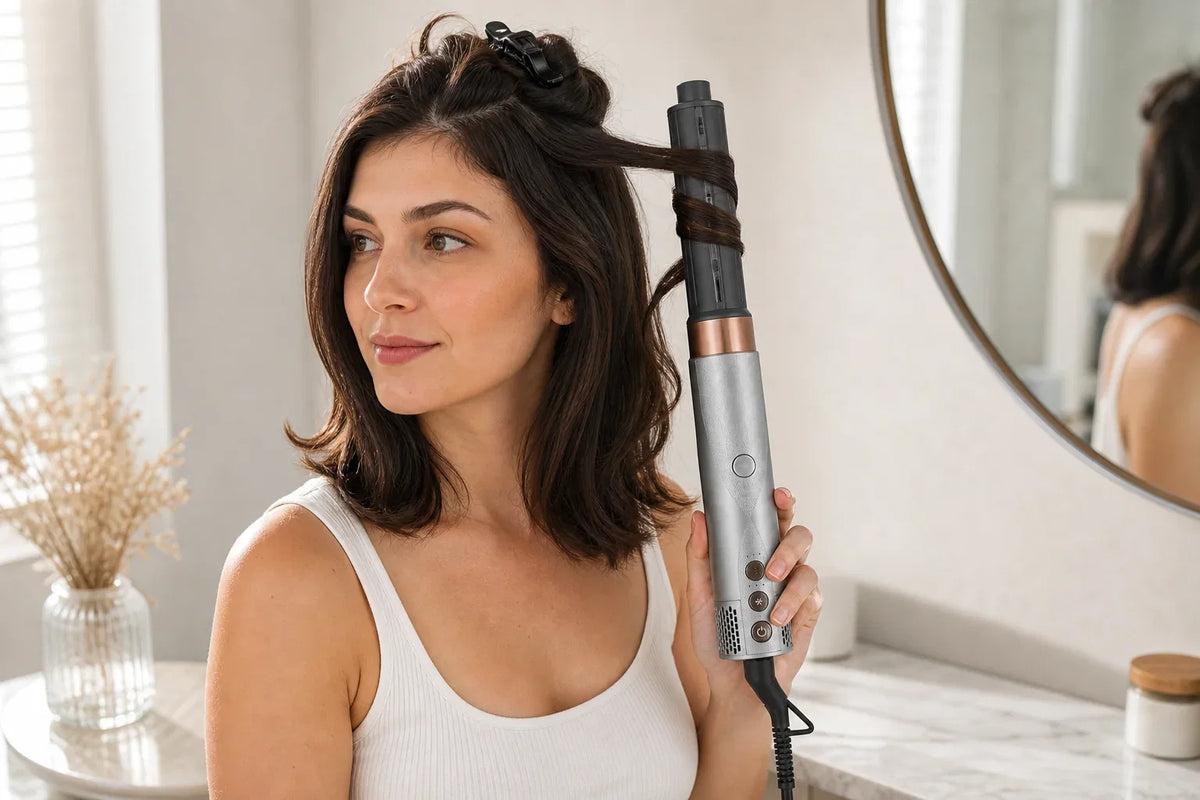
A hot air styler is an electric hair tool that combines moving air, controlled warmth, and a shaping surface or interchangeable attachment. Depending on the design, it can help take damp hair toward a dry finish while smoothing, adding volume, forming waves, or creating curls. The useful difference is not that it replaces every tool—it is that drying and shaping happen in the same coordinated routine.

What Is a Hot Air Styler?
A hot air styler is a powered styling tool that blows warm air through or around an attachment while you guide the hair. A simple model may look like a round brush with a built-in dryer. A multi-styler uses one powered handle with swappable heads for jobs such as focused drying, brushing, smoothing, volumizing, waving, or curling.
That makes it different from a conventional curling iron or flat iron. Those tools usually shape fully dry hair through direct contact with heated metal or ceramic surfaces. A hot air styler uses moving air as part of the process and is commonly designed to begin on damp or mostly dry hair. The exact starting moisture still depends on the manufacturer’s instructions.
Simple definition: a hair dryer moves air, a brush or barrel supplies shape and tension, and a hot air styler combines those actions in one handheld system.
“Hot air styler,” “air styler,” “multi-styler,” and “blow-dryer brush” are sometimes used loosely in product listings. Do not assume they describe identical tools. Look at the airflow source, included attachment forms, settings, and approved starting moisture before deciding how a model should be used.
How a Hot Air Styler Works
Three forces are doing different jobs: airflow removes moisture, warmth makes the section easier to shape, and controlled tension or wrapping guides the hair into the desired form. Good technique balances all three instead of relying on maximum heat.
1. Moving air carries moisture away
The motor pulls air through an intake and directs it through the attached head. As that air moves across the hair, it supports evaporation. A focused nozzle concentrates air for pre-drying or directional smoothing. A vented brush allows air to reach a section while the bristles organize it. A curling barrel directs air around hair that is positioned along the barrel.
The intake needs open space to work. Keep it clear of loose hair, lint, towels, and clothing. A blocked filter can reduce steady airflow and may cause the tool to run differently, so manufacturer-approved cleaning is part of performance—not an optional cosmetic chore.
2. Controlled warmth helps the section take shape
Warmth supports drying and makes hair easier to redirect around a brush or barrel. More heat is not automatically more effective. Oversized sections, poor detangling, inconsistent tension, or hair that is too wet can all make a routine slow even when the setting is high.
The American Academy of Dermatology advises using low or medium heat and limiting repeated heat exposure. Begin with the lowest effective combination of airflow and warmth, especially on fine, lightened, weathered, or breakage-prone hair. Increase only after testing a small hidden section and checking the model’s instructions.
3. The attachment provides direction and tension
Air alone dries, but the attachment decides how the section is organized. A round brush can lift the roots and create a soft curve. A smaller brush can give more control around shorter layers. A curling barrel encourages hair to follow a spiral path. A focused dryer head directs air without asking the hair to wrap around a brush.
Tension should feel controlled rather than aggressive. If the tool snags, stop and release the section instead of pulling harder. Detangling first and working with less hair usually solves more than added pressure.
4. Cooler air helps the result settle
A cool-shot feature does not permanently lock a style, but it can help a shaped section cool before you disturb it. That matters because a curl or lifted root can stretch out when it is brushed, pulled, or dropped while still warm. Hold the shape gently, use cool air as directed, release, and leave the section alone until it has cooled.
Hot Air Styler vs Other Hair Tools
The most useful comparison is not which tool is “best.” It is which one matches your starting moisture, preferred finish, and tolerance for switching between devices.
| Tool | Main action | Typical starting hair | Best suited to |
|---|---|---|---|
| Conventional hair dryer | Moves air through a nozzle or diffuser | Wet or damp, according to the dryer instructions | Fast rough-drying, root drying, diffusing, and brush-assisted blowouts |
| Hot air styler | Combines airflow, warmth, and a shaping attachment | Damp to mostly dry, depending on the model and attachment | Drying while smoothing, lifting, waving, or curling in one workflow |
| Blow-dryer brush | Uses a fixed brush head with built-in airflow | Usually damp or mostly dry, as directed | Simple blowout-style volume and smoothness with one brush form |
| Curling iron or wand | Uses direct contact heat on a barrel | Fully dry hair | Defined curl patterns, targeted touch-ups, and precise barrel work |
| Flat iron | Presses hair between heated plates | Fully dry unless explicitly designed otherwise | Crisp smoothing, polished straight finishes, and controlled bends |
| Wet-to-dry air straightener | Uses airflow and guided tension in a straightening form | Damp, towel-blotted hair when approved | Combining drying and straightening rather than switching among style heads |
Hot air styler vs hair dryer
A conventional dryer is flexible and can move a larger amount of air without the hair staying attached to a brush or barrel. It is often the direct choice for very wet roots, rough-drying, or a diffuser routine. A hot air styler makes shaping easier because the attachment is already connected to the airflow source, but it may work more efficiently after excess moisture has been removed.
Hot air styler vs blow-dryer brush
A blow-dryer brush is one form of hot air styler. The difference is usually scope: a fixed brush is built around one shape, while a multi-styler can accept several attachment types. If you wear the same smooth blowout most days, the simplicity of one brush may be ideal. If you alternate among pre-drying, volume, curls, and a smoother finish, an interchangeable system offers more options.
Hot air styler vs curling iron
A curling iron uses a heated barrel on fully dry hair and can create a more defined, deliberate curl. An air styler barrel shapes with moving air and warmth, often as part of the drying routine. The air-styled result may feel softer and more blowout-like. Curl longevity depends on preparation, section size, moisture, hair condition, product, cooling, weather, and technique—not the tool name alone.
Hot air styler vs wet-to-dry straightener
Both can combine drying and shaping, but their goals differ. A clamp-style air straightener guides hair along a straighter path. A multi-styler changes its working surface so you can move among a dryer head, brush form, and curl-focused attachment. For a deeper category comparison, see our guide to wet-to-dry hair straighteners.
What Can a Hot Air Styler Do?
A capable multi-styler can cover several common finishes, but each result comes from a different combination of attachment, section size, direction, airflow, warmth, and cooling.

Pre-dry and direct the roots
A focused dryer attachment can remove excess moisture before detailed shaping. Direct airflow down the hair rather than blowing every layer in different directions. Concentrate on the roots and hidden sections first, because a dry-looking surface can conceal damp hair underneath.
Create a smoother blowout finish
A vented brush supplies tension while air passes through the section. Work from underneath, lift away from the scalp, and guide the brush toward the ends without pausing in one spot. For more root lift, elevate the section before directing it forward or away from the face. For a detailed style concept, read what a blowout hairstyle is.
Add body and root volume
Volume comes from drying the root in a lifted position and letting it cool there. Place the brush under a manageable section, direct it upward rather than flat against the scalp, then pause only as the instructions allow. Cool the root before releasing. Our guide to adding volume to flat roots goes deeper into direction and section placement.
Form curls or waves
A curl-focused barrel guides a narrow section around its surface as air moves through the hair. Begin with hair at the moisture level specified for that attachment. Keep the ends controlled, use a consistent direction, cool the section, and release without stretching. Alternate directions for a relaxed finish or direct face-framing sections away from the face for a more open shape.
Polish ends and short layers
A smaller brush form can help around fringe, short layers, and the nape where a large head feels crowded. Keep the tool moving and maintain clearance from the scalp and ears. If short hair is your main concern, use the more specific styling tools for short hair guide rather than treating every attachment as equally suitable.
How to Use a Hot Air Styler: A Practical Routine
This framework applies broadly, but the manual supplied with your exact tool takes priority. Different heads may require different starting moisture, airflow, warmth, or attachment-locking steps.
- Towel-blot instead of rubbing. Remove excess water gently. Hair should not be dripping onto the tool, cord, counter, or outlet.
- Detangle before styling. Work from ends upward with a suitable comb or brush so the attachment does not have to pull through knots.
- Apply compatible protection. Use heat protection and styling products according to their directions; more product is not necessarily better.
- Check the manual’s starting moisture. If the attachment is intended for mostly dry hair, pre-dry first instead of forcing it through a soaking section.
- Connect the attachment securely. Power the tool off while changing heads, align the connector, and confirm that it locks as instructed.
- Divide hair into manageable sections. Clip away what you are not styling. The attachment should reach the complete section rather than only the surface.
- Begin with conservative settings. Start with the lowest effective warmth and an airflow level you can control.
- Shape with intention. Lift roots with a brush, direct ends around the curve, or guide a narrow section to a curl barrel without crowding the intake.
- Cool before release. Use cool air if the model provides it, then let the section settle before brushing or touching it.
- Switch off, unplug, and maintain. Allow the tool to cool before removing attachments or cleaning the intake as directed.

Why hair sometimes stays puffy or damp
The most common cause is a section that is too large or too wet. The surface dries first while moisture remains inside. Reduce the section, remove more water before styling, and keep a steady pace. If the roots stay damp, use the focused dryer head or the manual’s recommended preparation stage before returning to the shaping attachment.
Why curls fall quickly
A warm curl stretches. Give each section time to cool, avoid heavy brushing immediately afterward, and use consistent sections. Hair that is still damp inside may drop as remaining water evaporates. For a curl-specific troubleshooting path, see how to make curls last longer.
Why the tool feels harder to control over time
Fatigue, cord position, attachment size, and clogged airflow can all change handling. Work in a comfortable area, keep the cord clear, take breaks, and clean the detachable filter or intake exactly as directed. Stop if the tool sounds, smells, or behaves differently from normal.
What to Look for in a Hot Air Styler
Compare the routine behind the specifications. A long feature list is useful only when the tool’s controls and attachments solve styles you actually wear.
- Attachments that match your goals: prioritize the dryer, brush, or curl forms you will use rather than the largest package count.
- Separate, readable controls: distinct airflow and warmth choices make it easier to adapt to different hair areas and attachment jobs.
- Cool-shot access: the control should be comfortable to hold while the shaped section settles.
- Secure connection: heads should align and lock without wobbling; changing them should follow a clear powered-off routine.
- Comfortable handling: consider the complete tool with its attachment and cord, not only the bare handle.
- Maintainable intake: an accessible filter supports regular lint and hair removal according to the manual.
- Electrical compatibility: confirm the rated voltage, frequency, wattage, plug, and destination supply for the exact unit.
- Accurate package contents: verify what is actually included, especially when product copy and gallery images do not agree.
An outlet adapter changes plug shape; it does not automatically convert voltage. If the electrical details are unclear, ask the seller or a qualified source before purchase or travel. Do not infer compatibility from the product’s size or from the country where an advertisement appears.
How the NuvyCare Vorta Multi-Styler Fits the Category
The NuvyCare Vorta 5 in 1 Multi-Styler is a hot air multi-styler: one compact powered handle is designed to support drying, curling, smoothing, and volumizing with interchangeable attachment forms. The current product page describes LayerStream™ airflow, three airflow speeds, a Cool Shot control, and a detachable inlet filter.
That combination makes it most relevant to someone who wants several blowout-style finishes without keeping a separate powered tool for every job. Use the focused head for directional drying, a brush form for smoothing or lift, and a curl-focused barrel when the hair and attachment are prepared as directed. For a brush-specific selection and technique guide, read our curl styler brush guide.
The Vorta page currently supports broad performance positioning, but exact package contents and electrical specifications should be verified before ordering because parts of the live accordion content conflict with the five-attachment product imagery. This article does not repeat those conflicting numeric specifications or claim that a particular attachment is included in every current package.
The Bottom Line
A hot air styler earns its place by combining steps. Moving air dries, controlled warmth supports reshaping, and the attachment provides the tension or path that creates a smooth, lifted, wavy, or curled result. A multi-styler expands that idea with interchangeable heads, while a blow-dryer brush keeps it simple with one brush form.
Choose one if you regularly style damp hair and value a coordinated drying-and-shaping routine. Keep a conventional dryer, curling iron, or flat iron in the conversation if you need fast rough-drying, especially defined dry-hair curls, or a crisp plate-polished finish. Whatever the tool, use manageable sections, the lowest effective setting, complete cooling, correct electrical compatibility, and regular filter care.
Frequently Asked Questions
What is a hot air styler?
A hot air styler is an electric hair tool that combines moving air, controlled warmth, and a shaping surface or attachment. It can help dry damp hair while smoothing, adding volume, forming waves, or creating curls, depending on the model and head.
Can a hot air styler dry wet hair?
Many hot air stylers are designed for damp or mostly dry hair, but the approved starting moisture varies by model and attachment. Towel-blot first, never use the tool on dripping hair, and follow the exact manufacturer instructions.
Is a hot air styler the same as a hair dryer brush?
A hair dryer brush is one type of hot air styler with a fixed or primary brush form. A multi-styler is broader because one powered handle can accept different heads for focused drying, brushing, smoothing, volumizing, or curling.
Can a hot air styler curl hair?
Yes, when the model includes a curl-focused barrel or brush and its instructions support that use. Work with narrow sections at the correct moisture level, keep the intake clear, cool the shape before release, and avoid stretching the curl while it is warm.
Is a hot air styler better than a curling iron?
Neither is universally better. A hot air styler can form soft curls or waves while supporting the drying routine. A curling iron works on fully dry hair and can provide more defined, targeted barrel styling. Choose by starting moisture and preferred finish.
What should I look for in a hot air styler?
Look for attachment forms that match your styles, controllable airflow and warmth, accessible Cool Shot, a secure locking system, comfortable handling, a maintainable intake, clear starting-moisture guidance, and electrical specifications compatible with your location.
Share:
Flat Iron vs Hair Straightener: Which One Fits Your Routine?
What Is a Floating Head Shaver? How Contouring Blades Follow Your Face