
FACIAL GROOMING · BUYING GUIDE
Foil Shaver for Face: Who It Suits and What to Look For
A foil shaver for face grooming is worth considering when you want to remove short facial stubble for a clean-shaven look. It is a different purchase from a beard trimmer that keeps a chosen length. The right match depends on the finish you want, the growth you usually start with, and how comfortably you can place the shaving head around your face.
This guide helps you decide whether a facial foil shaver belongs in your routine and what to check before choosing one. It is a category-selection guide, not a hands-on ranking: no single model is the best choice for every face, and a long feature list cannot establish how it will feel on yours.

Start With Your Grooming Goal, Not the Blade Count
Two people can search for a facial shaver and need quite different tools. One wants to remove yesterday's stubble; the other wants a tidy beard without losing its length. Decide what you want left on your face before comparing motors, accessories, or the number of cutting elements.
| Your main goal | Where a foil shaver fits | Check first |
|---|---|---|
| Remove short facial stubble | A relevant category to shortlist | Facial-use instructions and normal starting length |
| Keep a visible, even beard | Not the main length-setting tool | A beard trimmer with suitable guards |
| Clean up outside a beard outline | May serve as a finishing tool | Head access and a separate edging option |
| Remove much longer growth | May follow a pre-trim | The exact model's length limits |
| Remove fine facial fuzz or shave other areas | Do not assume compatibility | A device intended for that hair and body area |
If keeping a particular beard length is your priority, start with our electric shaver vs. beard trimmer guide. Buying a close-shaving tool and trying to make it leave uniform stubble is a mismatch of purpose, even if the tool itself works well.
What Makes It a Facial Foil Shaver?
A foil shaver has a thin, perforated metal screen over moving cutters. Hair enters the openings and is cut beneath the screen. The foil is the skin-facing surface; the moving cutter is not an exposed manual razor blade. Braun's introduction to electric shaving explains this barrier and notes that an electric shave can leave some stubble compared with other razors.
Think of “foil” as the cutting layout and “for face” as the intended job. Neither phrase tells you the head's size, permitted beard length, wet-use compatibility, or included attachments. A pocket shaver, a full-size facial shaver, and a barber's finishing tool can all use foil technology without being interchangeable purchases.
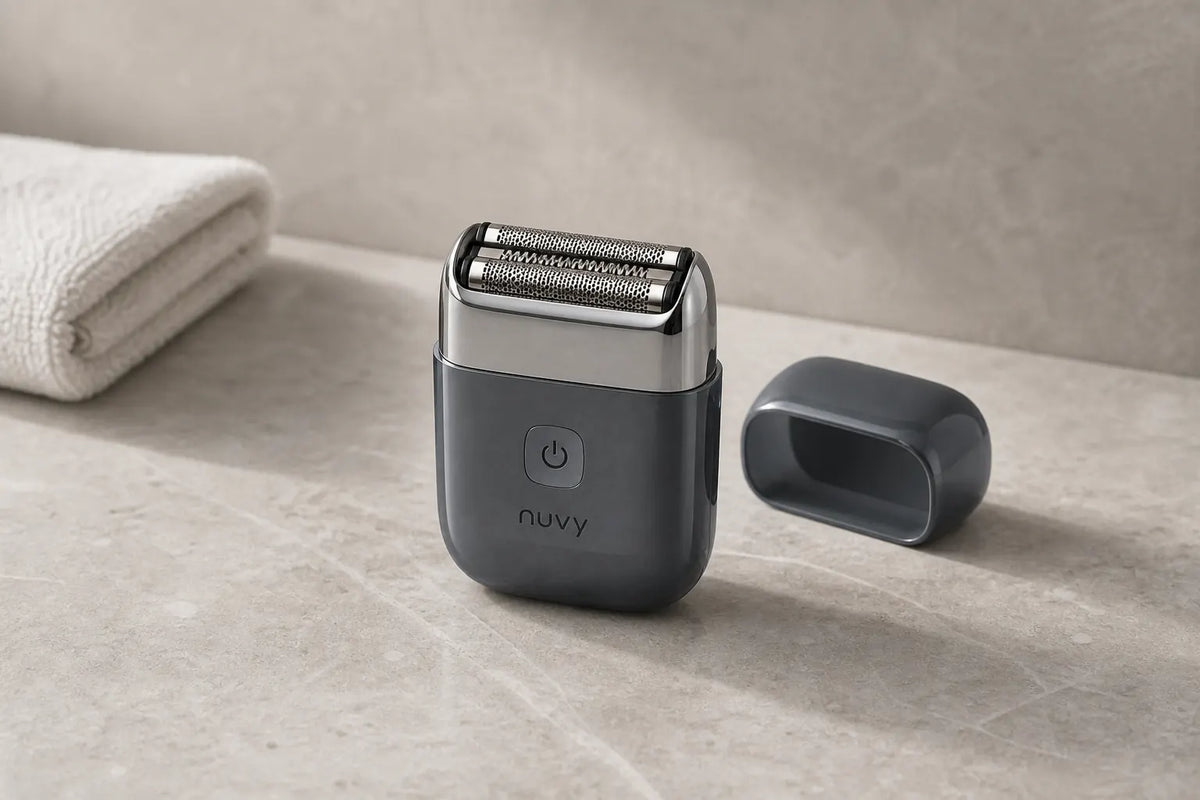
Also separate the number of shaving sections from the number of tools in the box. A central cutter between two foil areas is part of the shaving system; it is not automatically a pop-up detail trimmer. If you need an attachment for shaping sideburns or keeping stubble, look for that item by name in the package contents.

For the broader choice between circular and linear cutting layouts, see our rotary vs. foil shaver comparison. Here, the question is narrower: once a foil design is on your shortlist, does its particular format suit your facial-grooming job?
Who Is a Foil Shaver for Face Grooming a Good Match For?
You prefer a clean-shaven appearance to styled stubble
Your desired finish is the clearest starting point. If you normally remove facial hair rather than preserve a beard shape, a facial foil model deserves consideration. Judge it by the combination of appearance, comfort, and the time your usual shave takes—not by how often you can rub the same patch until every trace of texture disappears.
“Clean-shaven” is an appearance, not a promise that every face will feel identical. Hair color, density, skin response, and lighting affect what you see. A lingering shadow is not by itself proof that the machine needs more pressure or that another pass will improve the result.
Your usual starting point is manageable stubble
A routine that keeps growth short is a sensible context in which to evaluate a foil shaver. Do not turn that into a universal rule about shaving every morning: growth rates differ, and some models are designed to handle longer growth than others. Check the manual's guidance for the specific machine rather than assigning the whole category a fixed number of days.
Consider the routine you actually follow. If you regularly take long breaks between shaves, include the possible need for pre-trimming in your decision. A purchase that requires a second tool is not necessarily wrong, but it should be deliberate.
You want clean surrounding areas while keeping a beard
A facial foil shaver can have a supporting role for someone who retains a mustache or beard. The relevant question is whether its head can reach the area to be cleared without taking hair you want to keep. Removing nearby stubble and drawing a crisp outline are separate jobs; do not assume a broad foil cassette is also a precision edger.
Look at the head from the angle you would see it in a mirror. Can you identify where the active shaving surface begins and ends? A body that hides that boundary may be less intuitive for close work beside a beard, regardless of its advertised power.
When Another Tool—or a Different Priority—Makes More Sense
For a maintained beard: prioritize adjustable length control. A shaver's ability to remove short hair is not a substitute for a trimmer's guards. If a product combines both jobs, verify which attachments are actually supplied with the exact version you are ordering.
For fine facial fuzz: do not assume a beard-focused foil device is the same as a small facial-hair remover marketed for fine hair. Check the intended facial areas and hair types. Labels such as “men's” or “women's” tell you less than the instructions and the shape of the working head.
For scalp or body grooming: facial suitability does not automatically establish suitability elsewhere. Choose a device whose manufacturer identifies the intended area and any required guards. A shared cutting technology does not make all skin-contact applications equivalent.
For recurring razor bumps: closeness may be the wrong buying priority. The American Academy of Dermatology's razor-bump guidance advises avoiding very close shaving and heavy pressure. Persistent bumps or irritation deserve advice from a dermatologist, not a stronger product promise. No foil design guarantees an irritation-free shave.
Finally, avoid using one unusual shave as your entire purchase brief. A tool for occasional beard removal may need different capabilities from one for regular short-stubble maintenance. Write down the main job and the occasional job separately; then decide whether you need one device or a combination.
What to Look For in a Facial Foil Shaver
The best foil shaver for face grooming is the one that fits your actual requirements. Use the checks below to compare shortlisted models consistently. They are buying questions, not a claim that the most expensive or most feature-rich option will shave you best.
Head access where your face needs it
Compare the active shaving area with the surrounding plastic or metal frame. A wide head may offer useful coverage on the cheeks but take more planning beside a mustache or beneath the nose. A smaller one may be easier to position in a narrow space while requiring more passes across a broad area. These are tradeoffs to assess, not automatic wins for either size.
Product photos should show the cap off and the head from above. A beautiful closed-body image does not answer how much of the shaving surface can reach a tight corner. If possible, assess the grip too: your fingers should not obscure your view of the head or rest awkwardly over the power switch.
A clearly explained contour system
Ask whether individual shaving sections move, whether the whole cassette tilts, or both. “Floating” and “pivoting” are not interchangeable descriptions. Our floating-head shaver explainer covers the mechanism in detail; for buying purposes, look for a clear picture and an explanation of what actually moves.
More movement is not automatically better for every user. Predictable placement around your particular contours matters more than an impressive-sounding term. Do not infer a large pivot range from a claim about flexible cutting elements.
A realistic answer about growth length
Look for model-specific guidance on the hair the shaver is intended to tackle. If you often start with longer growth, ask whether pre-trimming is recommended and whether the necessary trimmer is included. Motor-speed language alone does not answer either question.
Keep hair thickness separate from hair length. A short, dense beard and a longer, sparse beard present different buying questions. If firm, coarse hair is your main concern, our coarse-hair shaver guide examines that narrower situation.
Explicit permission for your preferred wet or dry routine
Read wet-shaving compatibility, rinse-cleaning instructions, and charging restrictions as separate items. Do not infer that a waterproof label permits every wet-use situation. If you want to shave with foam or gel, the manufacturer should specifically allow it. If you want a dry routine, confirm how the head should be prepared and maintained.
Convenience depends partly on what follows the shave. Check how the head opens, which parts can be rinsed, and where the device can dry. A routine that fits your space is more useful than an extra capability you rarely use.
Ownership details beyond the first purchase
Find out how to obtain a compatible replacement foil or cutter, not just whether the head is removable. Those are different questions. Check current part availability, compatibility, and the manufacturer's care instructions; avoid assuming that a replacement interval quoted for another brand applies to your model.
Include accessories and after-sales terms in the comparison. Does the package contain a protective cap, a cable, or an adapter? Is an accessory in a lifestyle photo actually included? Read the seller's current returns policy, especially any conditions for opened grooming products, before treating an at-home trial as risk-free.
Useful evidence instead of universal rankings
Read reviews for context: the reviewer's starting growth, chosen finish, and exact model matter. A complaint about beard edging may be irrelevant if you remove all facial hair; praise for a compact travel size may say little about full-face shaving speed. Prefer descriptions of the task over a bare star rating.
Keep your comparison simple. List your three essential requirements, then mark what is confirmed, what is optional, and what still needs an answer. An unanswered question should stay unanswered—not become a feature you assume the product has.
Where the Nuvy Nova Shaver Fits
The Nuvy Nova Shaver is NuvyCare's compact facial foil option. Its current product page lists three floating shaving sections, an ultra-thin foil, wet and dry use, and IPX7 waterproofing. The listed package includes a protective cap, Type-C charging cable, cleaning brush, user manual, and protective case.
That combination makes it a candidate if you want a compact foil format and the flexibility to choose an approved wet or dry routine. It does not establish a universal winner for closeness, beard density, or skin comfort. A precision beard-trimmer attachment is not listed in the box contents; plan separately if length control or edging is essential.

Before ordering, review the Nova's current specifications and care instructions and confirm replacement-part availability with NuvyCare if that affects your decision. Follow the supplied manual for movement, cleaning, and charging; generic foil-shaver advice should not override it.
Your Final Buying Checklist
Before you add a facial foil shaver to your routine, make sure you can answer these questions:
- Do I want a clean-shaven finish, or do I actually want to keep a chosen beard length?
- Does the model suit the growth I usually start with, including days when I skip shaving?
- Can I see and position the active head around the facial areas I need to reach?
- Is my preferred wet or dry routine explicitly supported?
- Are any required trimming attachments, replacement parts, and charging items confirmed?
- Have I read the care instructions and current purchase terms?
A clear answer to those questions is more valuable than another superlative on the box. Shortlist by the job, compare the exact model, and leave room for individual differences in the result. A well-matched foil shaver should make sense as part of your routine before you ever switch it on.
Frequently Asked Questions
Is a foil shaver good for your face?
A model intended for facial use can be a good option for removing short stubble. Check its permitted hair length, head access, and wet or dry instructions. Being a foil shaver does not guarantee that it suits every face or skin condition.
Can a foil shaver replace a beard trimmer?
Not if you want to maintain a chosen beard length. A foil head is for close shaving; a trimmer with suitable guards controls retained length. Some devices combine functions, but you need to confirm the attachments included with the exact model.
Can I use a facial foil shaver on long beard hair?
Check the model's instructions. Some designs handle longer growth, while others may need the beard shortened first with a suitable trimmer. Do not assume every foil shaver has the same length capability or force poorly captured hair into the head.
Are all foil shavers suitable for wet shaving?
No. Wet use must be explicitly permitted for the model, including any use with foam or gel. Rinse-cleaning permission alone is not enough. Follow the manufacturer's restrictions on water exposure and charging.
Is a foil shaver automatically better for sensitive skin?
No. The foil separates the moving cutters from direct skin contact, but it does not guarantee comfort or prevent razor bumps. Individual skin response matters. If irritation or bumps persist, ask a dermatologist rather than repeatedly pursuing a closer shave.
What is the best foil shaver for face grooming?
There is no universal best model. Match the head size, intended hair length, wet or dry options, care needs, and available parts to your routine. If you need beard edging or length control, verify a suitable attachment or plan for a separate tool.
Share:
Round Brush Blowout: A Step-by-Step At-Home Technique
Best Hair Straightener for Frizzy Hair: Features That Matter